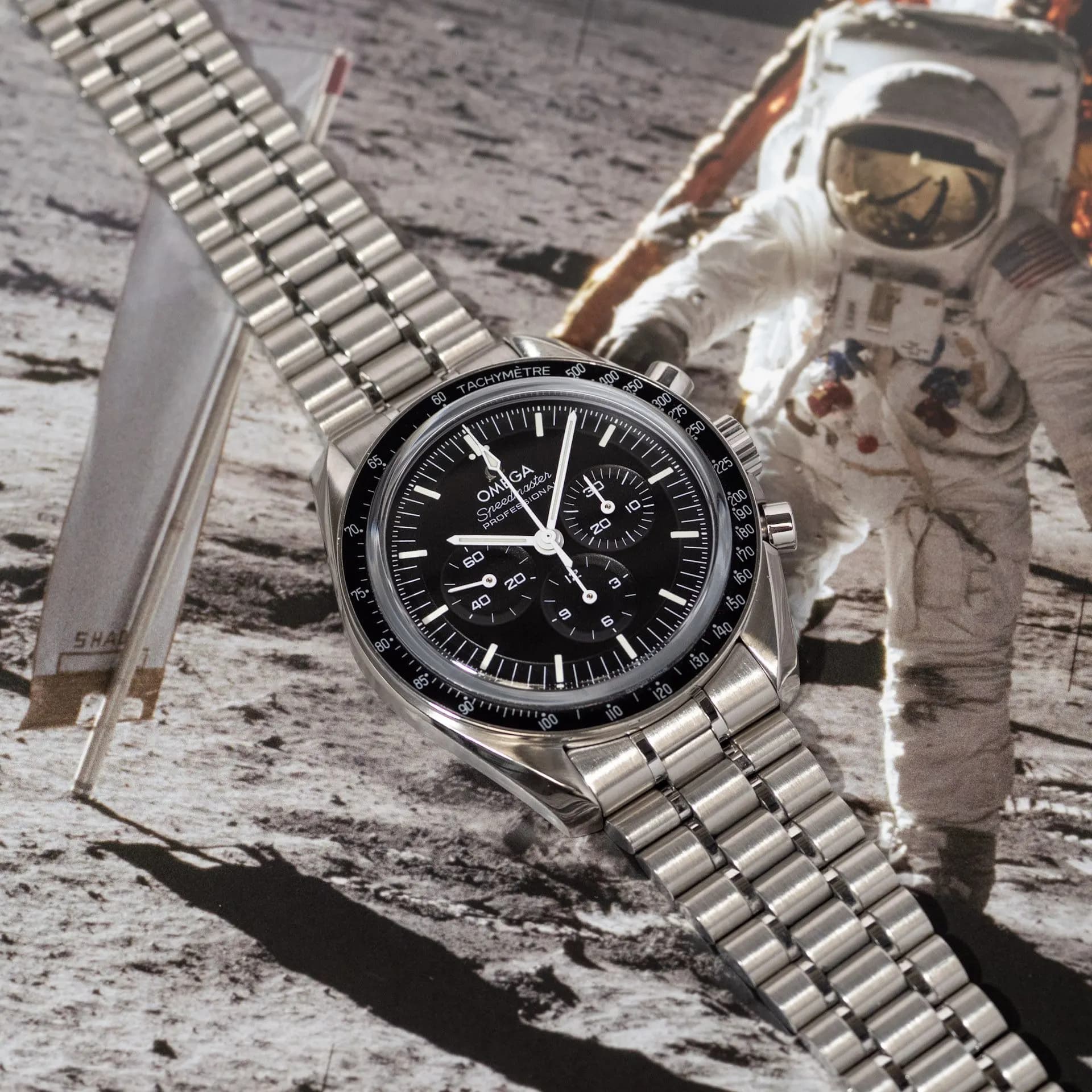
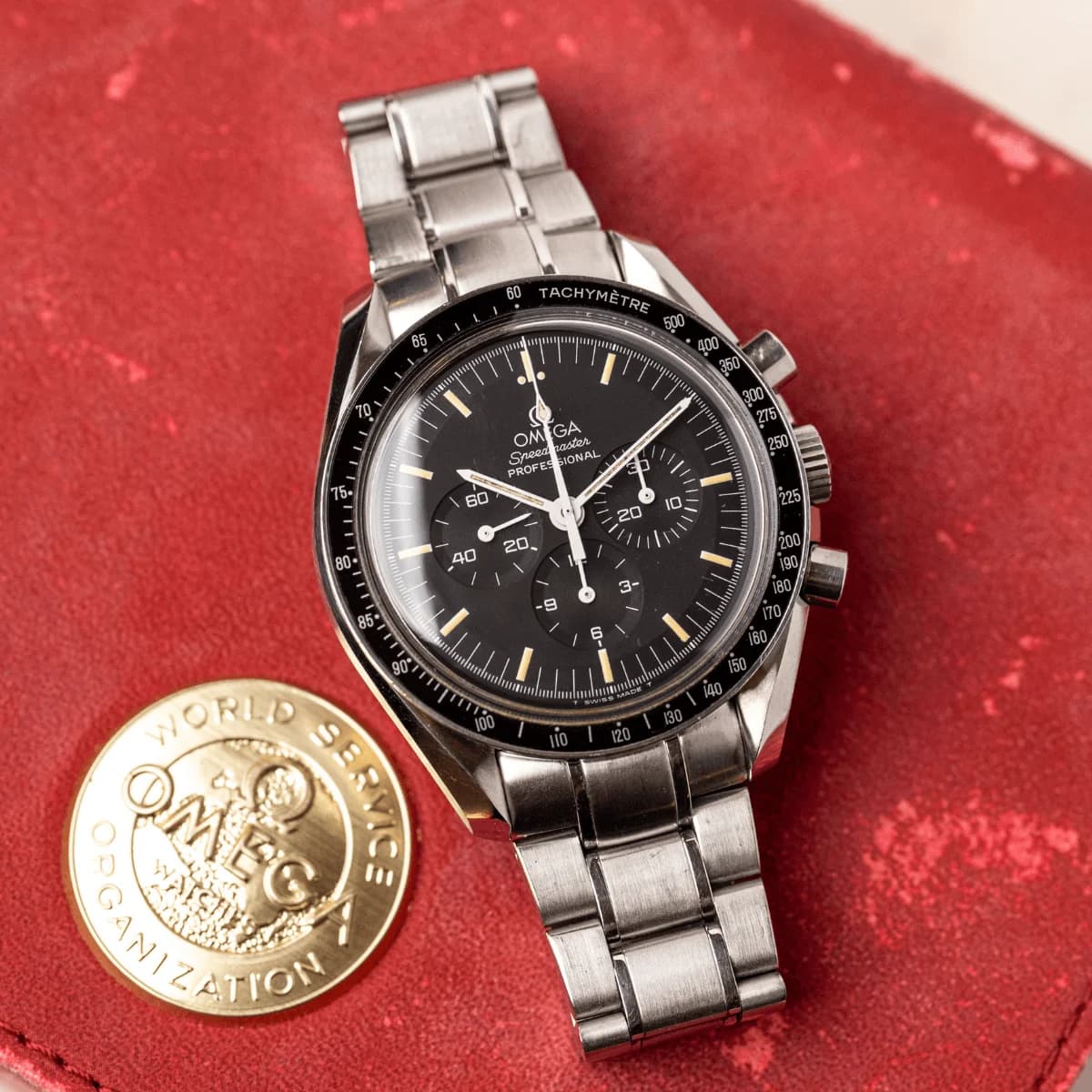
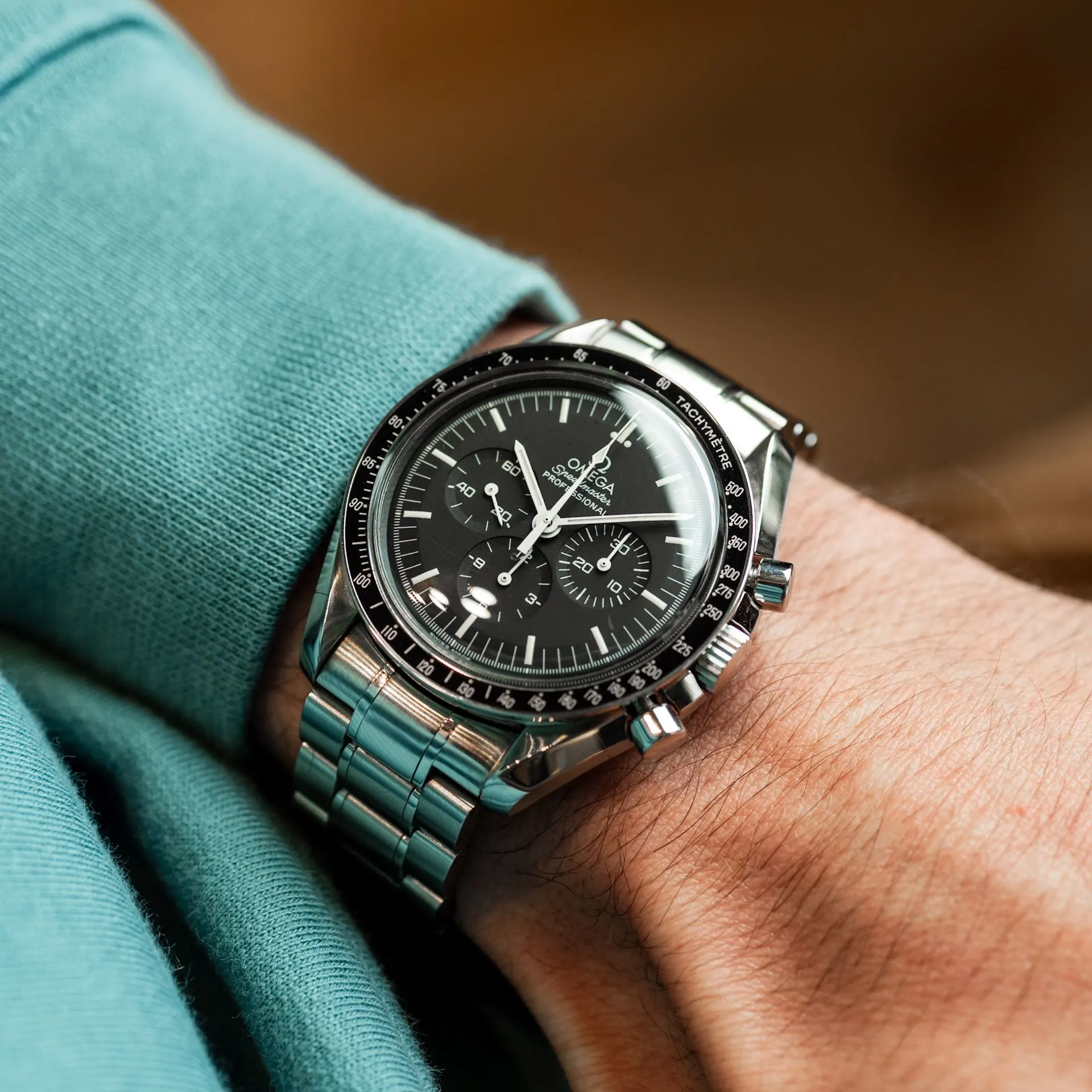
In 1957, the watchmaking brand Omega simultaneously introduced three watches designed for professionals: the Seamaster 300, the Railmaster, and the Speedmaster. None of the engineers in Bienne could have imagined at the time that their new chronograph for racing drivers would end up, twelve years later, on the wrist of Buzz Aldrin some 384,000 kilometers from Earth. And yet, that’s exactly what happened. It was there — far beyond its original specifications — that the real story of the Speedmaster truly began.
As the Artemis mission has just returned to Earth after orbiting the Moon—the famous “Dark Side of the Moon”—let’s take a look back at the iconic references of the “Moonwatch.”
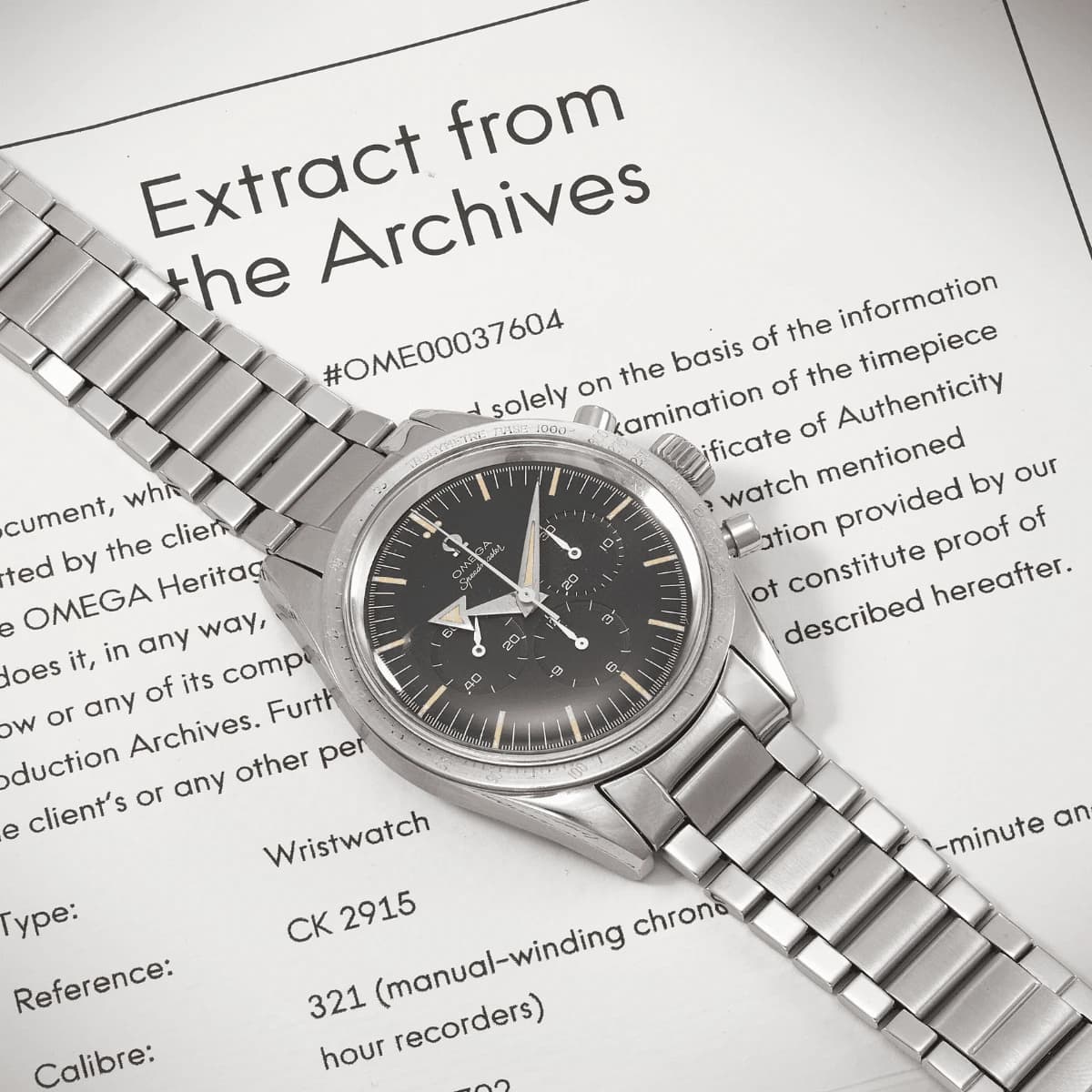
The first reference: Speedmaster CK 2915, known as the "Broad Arrow"
The first Speedmaster was launched in 1957. Its design is often attributed to Swiss designer Claude Baillod—although this has never been officially confirmed by Omega. It met a simple and precise requirement: to offer racing drivers and sports professionals a chronograph that was accurate, legible, and robust.
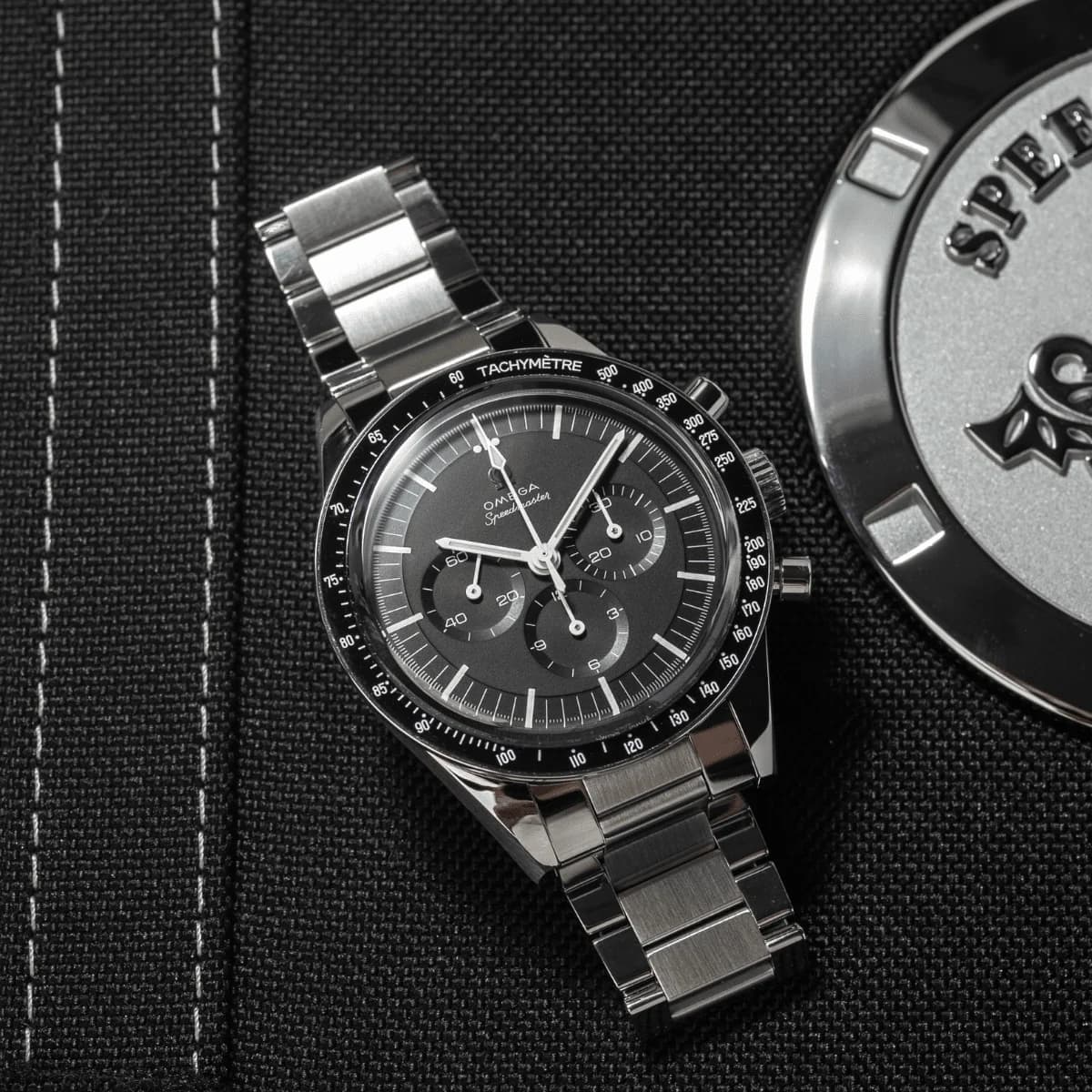
The brief was successfully fulfilled: a 39 mm stainless steel case, a high-contrast black dial, a triple-register chronograph layout (tricompax), and above all, a major innovation that was unprecedented in the industry at the time—the tachymeter scale engraved on a fixed steel bezel rather than on the dial, freeing up visual space and improving legibility.
Note: contrary to what is sometimes stated, this bezel is fixed—it does not rotate.
The nickname “Broad Arrow” comes from its distinctive hands, with their wide arrow-shaped tips, giving it an immediately recognizable visual identity. The brushed steel bezel features engraved tachymeter markings.
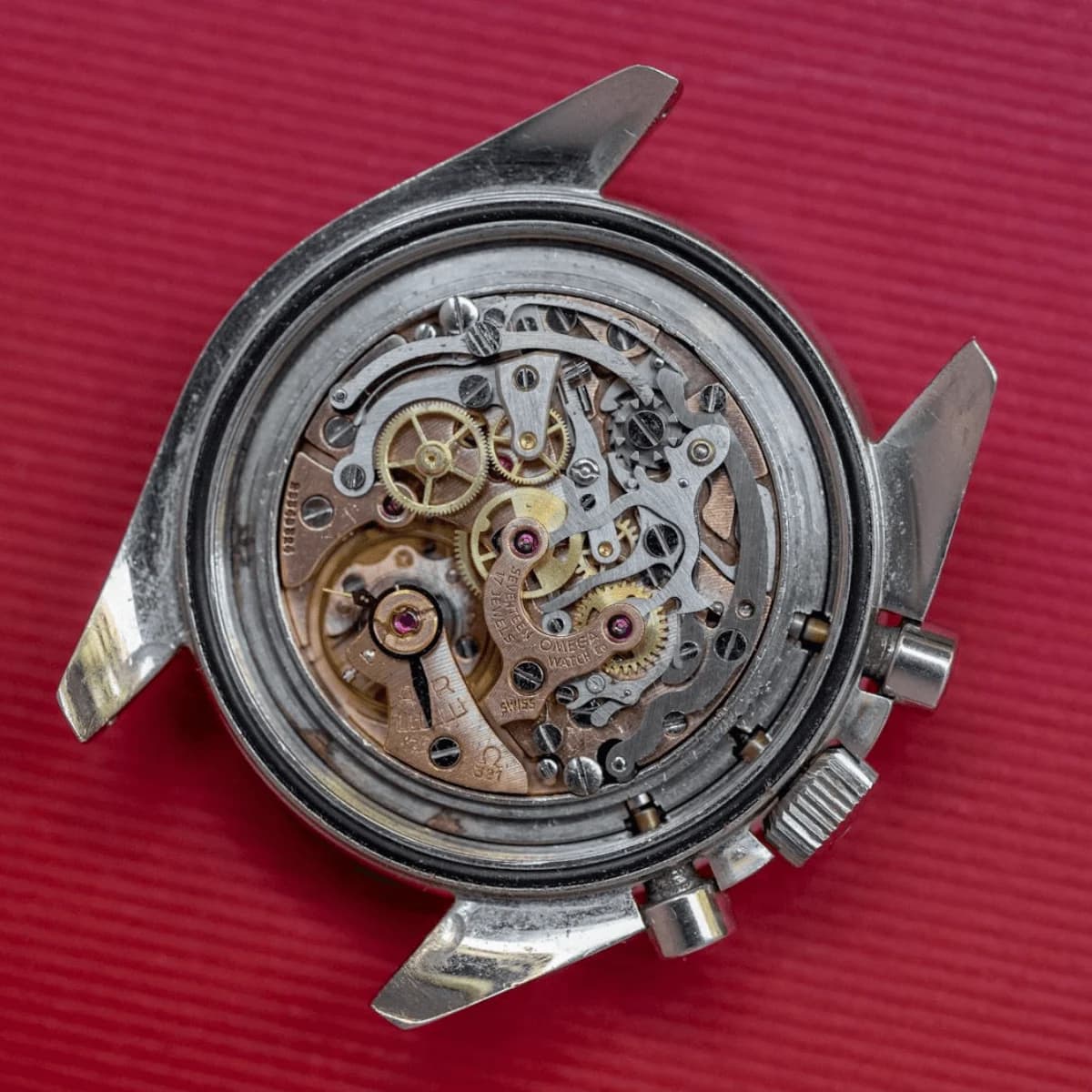
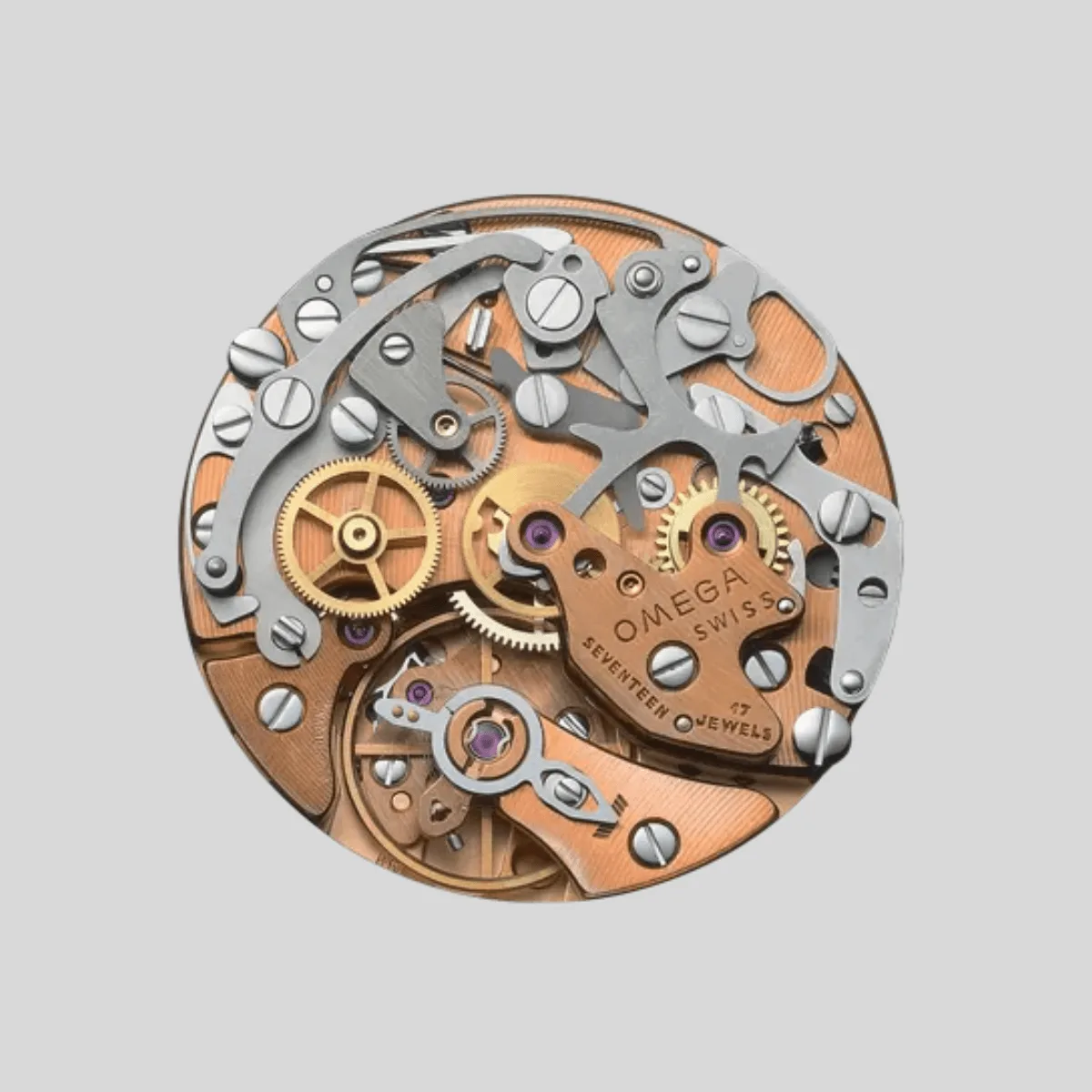
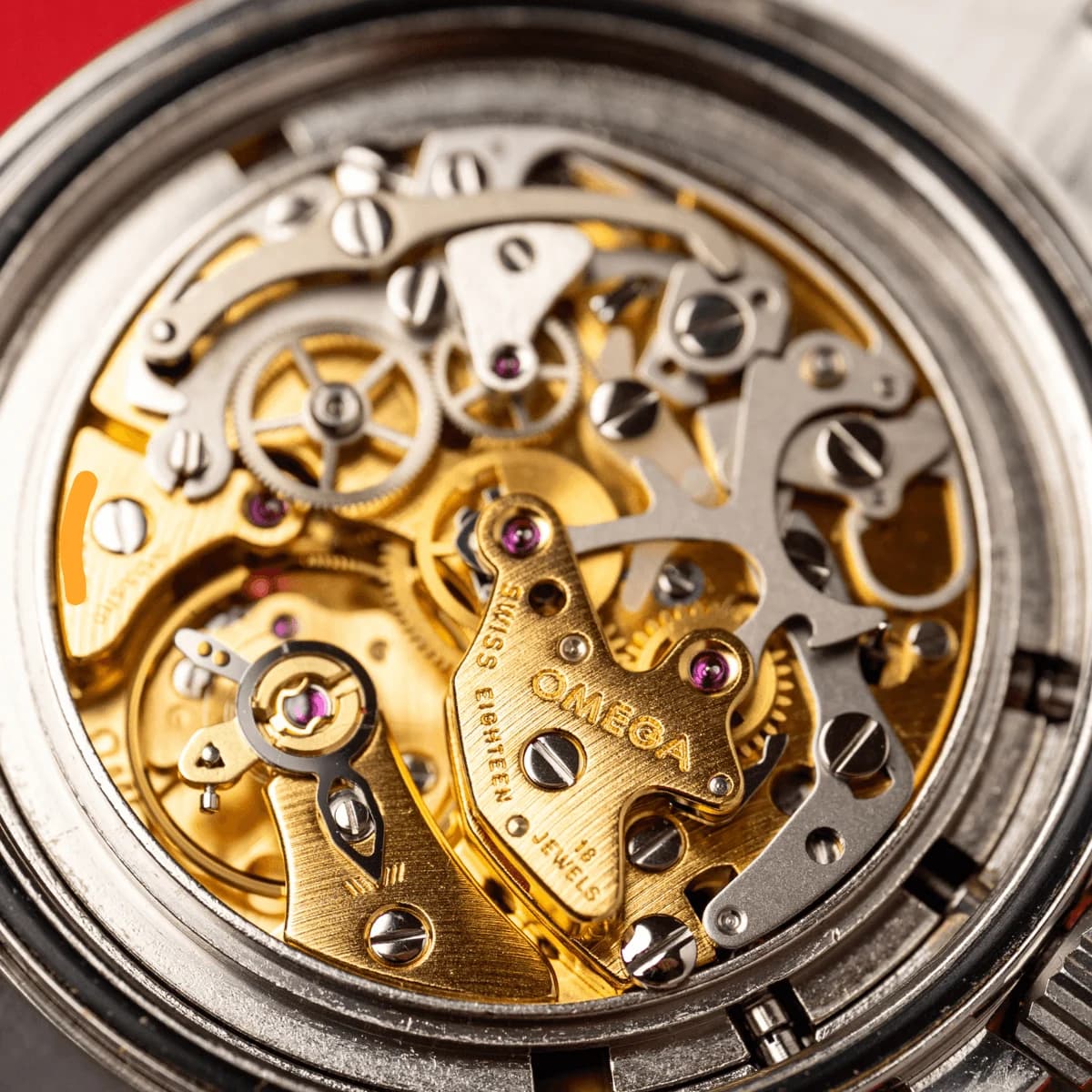
The movement powering it is the Calibre 321, developed in collaboration with Lemania, a subsidiary of Omega. This manual-winding calibre is regarded as one of the finest examples of a column-wheel chronograph with lateral clutch ever produced—to the point that Patek Philippe, Breguet, and Vacheron Constantin adopted it for their own high-end chronographs. Its proven robustness and reliability would prove decisive for what came next.
Production of the CK 2915 reference is estimated at between 3,000 and 4,200 pieces, based on cross-referencing by collectors and partial archival records, making it one of the most sought-after Speedmasters among collectors today. In May 2018, during the Geneva Watch Auction organized by Phillips, a 1958 CK 2915-1 sold for CHF 408,500—a record later surpassed in 2021 by another example of the same reference.
These production figures and dates are based on the empirical observations of collectors and professionals over time. None of this has been officially confirmed by the manufacture.
The CK 2998 reference: first evolutions
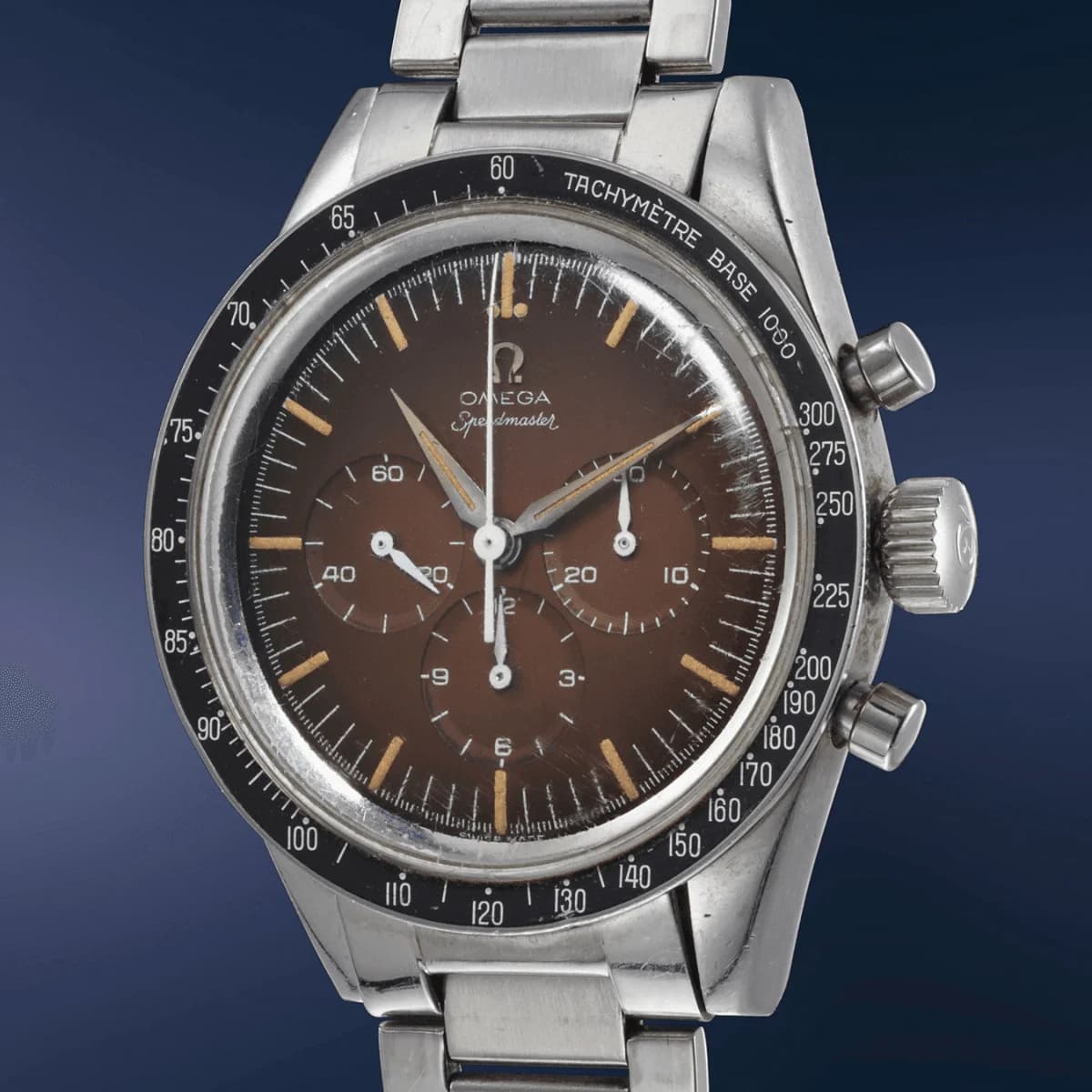
In 1959, Omega introduced the second generation of the Speedmaster under the reference CK 2998. The case was slightly enlarged to 40 mm. The brushed steel bezel of the Broad Arrow was replaced by a black anodized aluminum bezel, offering much better legibility and contrast. The so-called “alpha” hands replaced the Broad Arrow style—the model moved in a more restrained and functional design direction.
It is also on this reference that the O-ring gasket around the pushers first appeared, improving water resistance. The CK 2998 was produced in eight sub-variations between 1959 and 1963, with differences mainly relating to the bezel scale (base 1,000 or not) and certain dial printing details. The most sought-after variation among collectors is the one featuring the so-called “lollipop” seconds hand.
It was also a CK 2998—his personal watch—that astronaut Wally Schirra wore during the Mercury-Atlas 8 mission on October 3, 1962, making the Speedmaster the first watch to enter space.
The ST 105.003 reference: the NASA-qualified Speedmaster
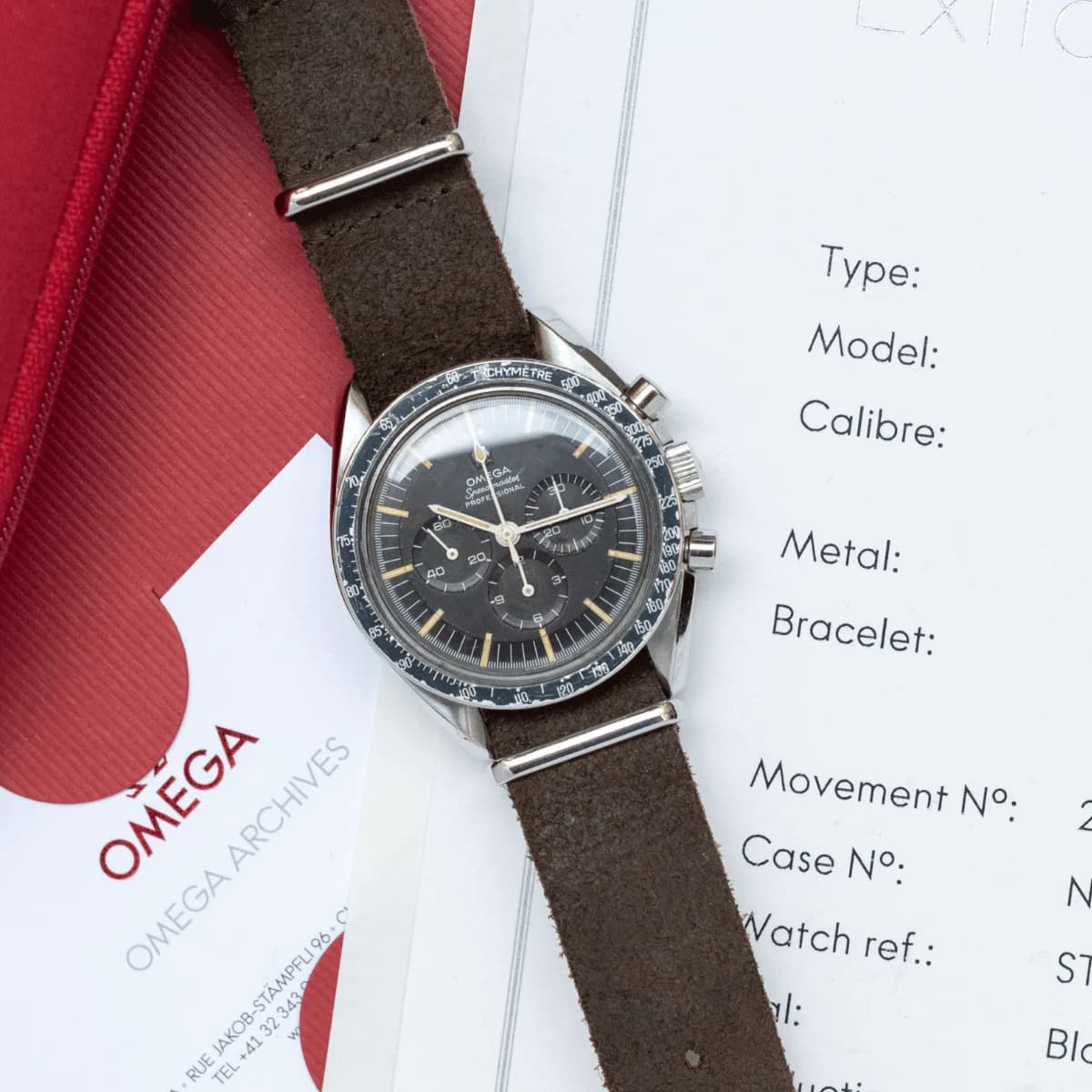
In 1963, Omega introduced the baton hands that would become the model’s definitive visual signature. This was the ST 105.003 reference—featuring a straight case, without crown guards. The 42 mm asymmetrical case with crown guards would only appear with the ST 105.012 reference, in 1964. This evolution would go on to become one of the Speedmaster’s most iconic design features.
It was this generation—the third—that NASA subjected to its famous eleven qualification tests in 1964. The conditions were deliberately extreme: temperature variations from -18 to +93°C, ultraviolet exposure, magnetic fields of 10,000 gauss, violent shocks up to 40 G, sustained vibrations, and simulated space vacuum...
Rolex, Longines-Wittnauer and Omega responded to the call for tenders. Only one chronograph passed all the tests without failure: the Speedmaster.
On March 1, 1965, NASA officially declared the watch “Flight Qualified for All Manned Space Missions.” Omega discovered the news in a rather amusing way: by seeing the photograph of Ed White during the first American spacewalk in June 1965, with a Speedmaster clearly visible, strapped over the sleeve of his suit. The word “Professional” appeared on the dial shortly thereafter.
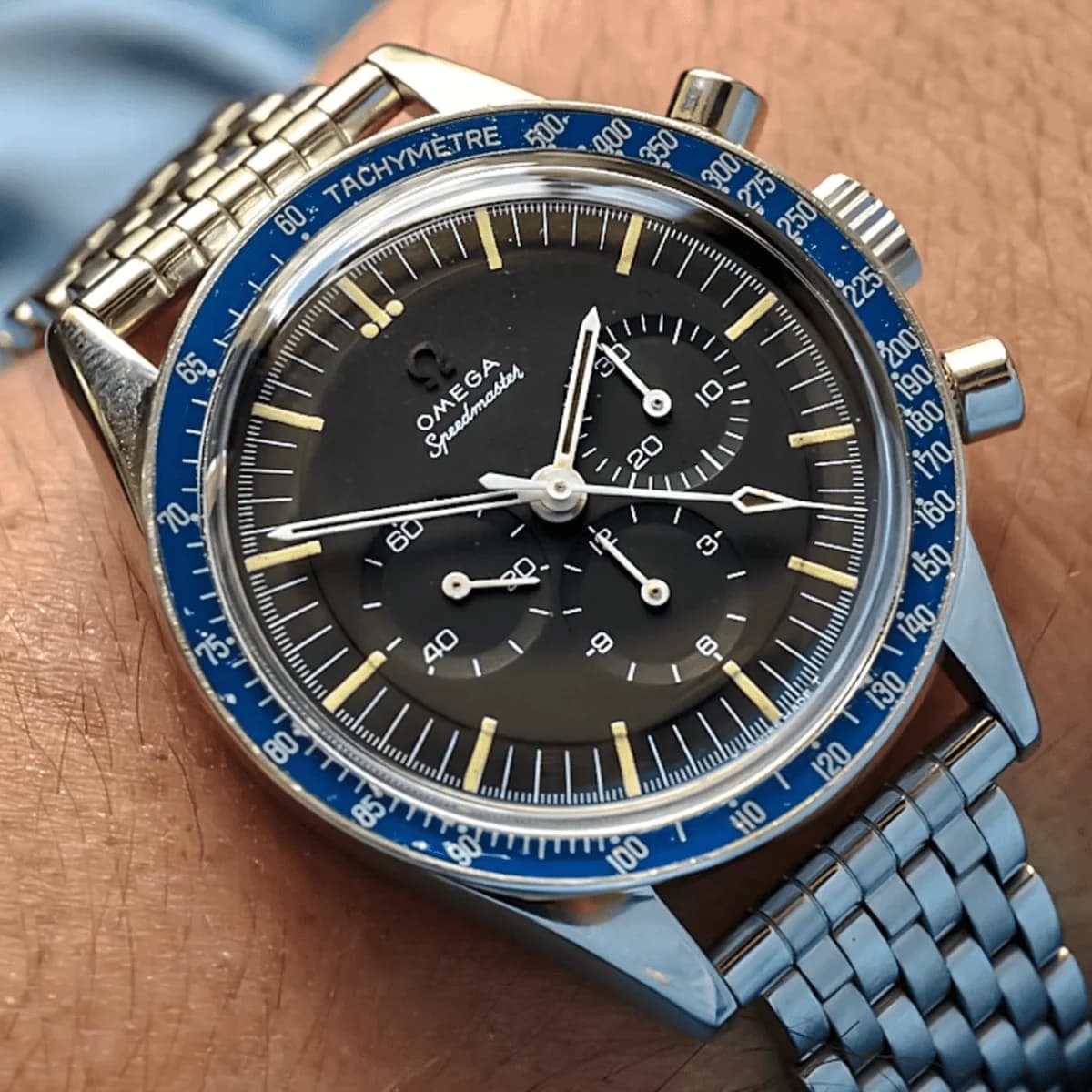
Note: Blue bezels are mainly found on the 105.003-64 and 105.012-64, although they can also appear on other references. Serial numbers are generally within the 2208XXXX and 20527XXX ranges, especially on -64 models (see more details on Hairspring)
The ST 105.012 reference: the true “Moonwatch”
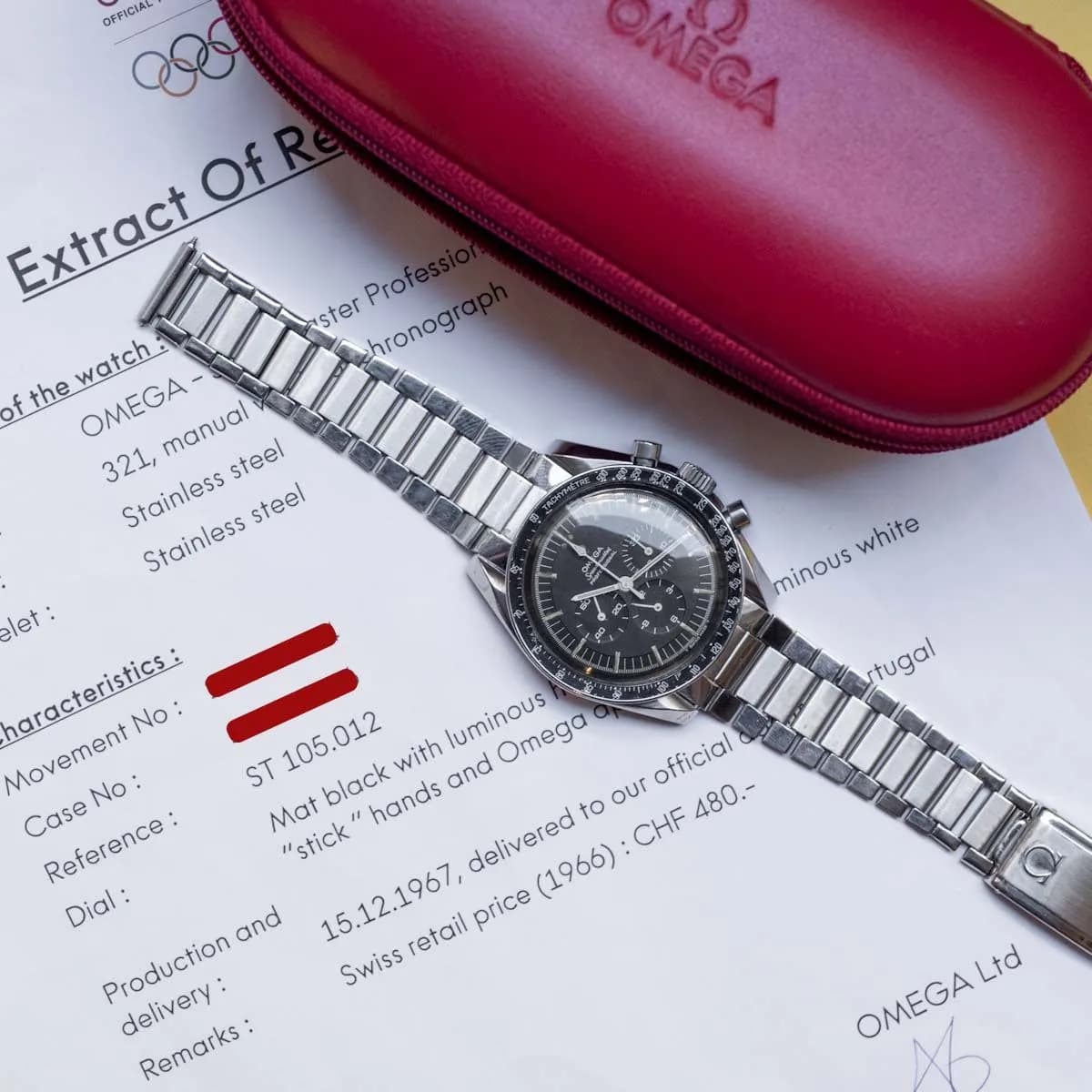
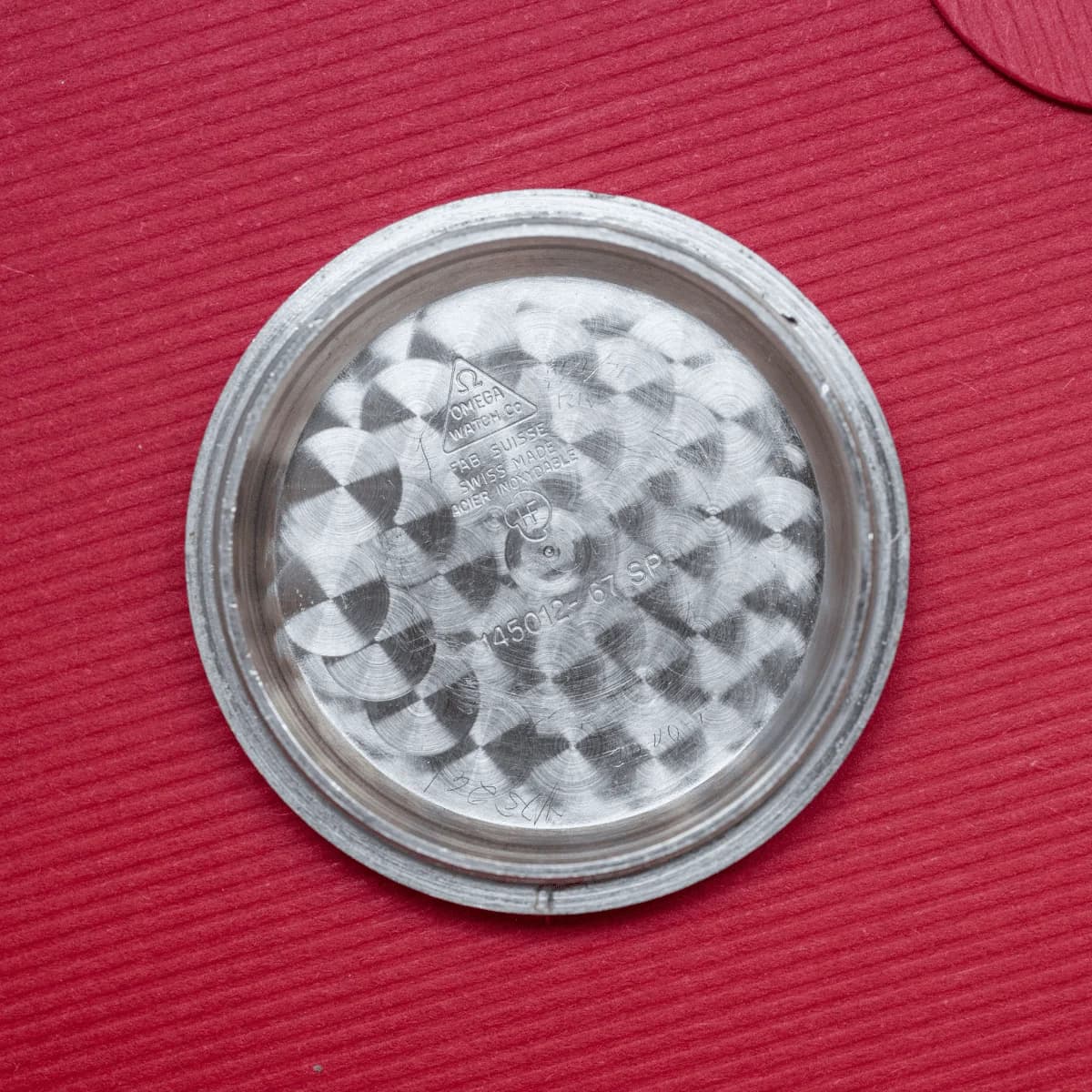
In 1964, Omega introduced the ST 105.012 reference, the first to officially feature the word “Professional” on the dial. It was this model—with its 42 mm asymmetrical case, crown guards, black dial, and Calibre 321—that would be worn by astronauts throughout the Gemini program and Apollo program missions. It is the very watch that Buzz Aldrin wore on the Moon on July 20, 1969, during the Apollo 11 mission.
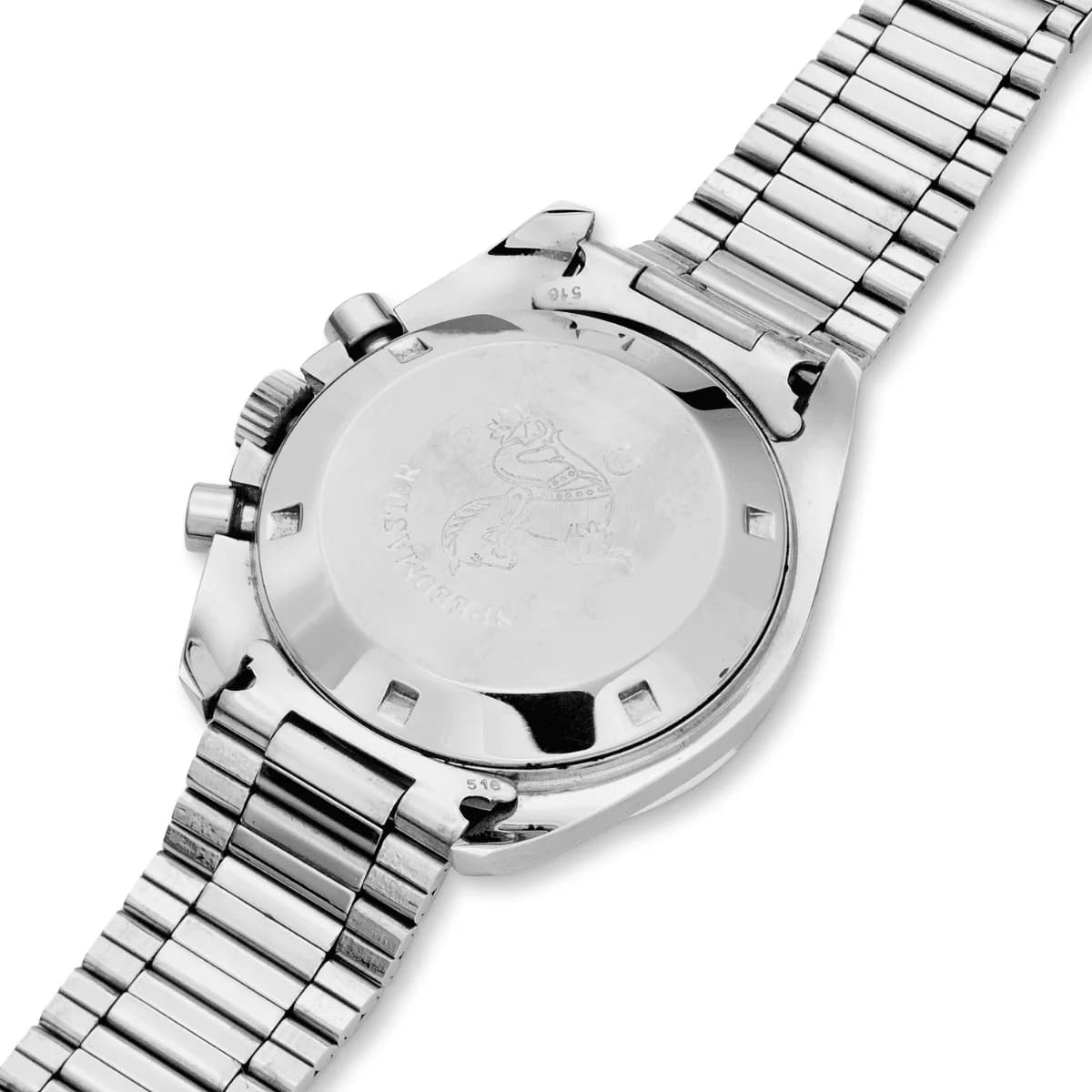
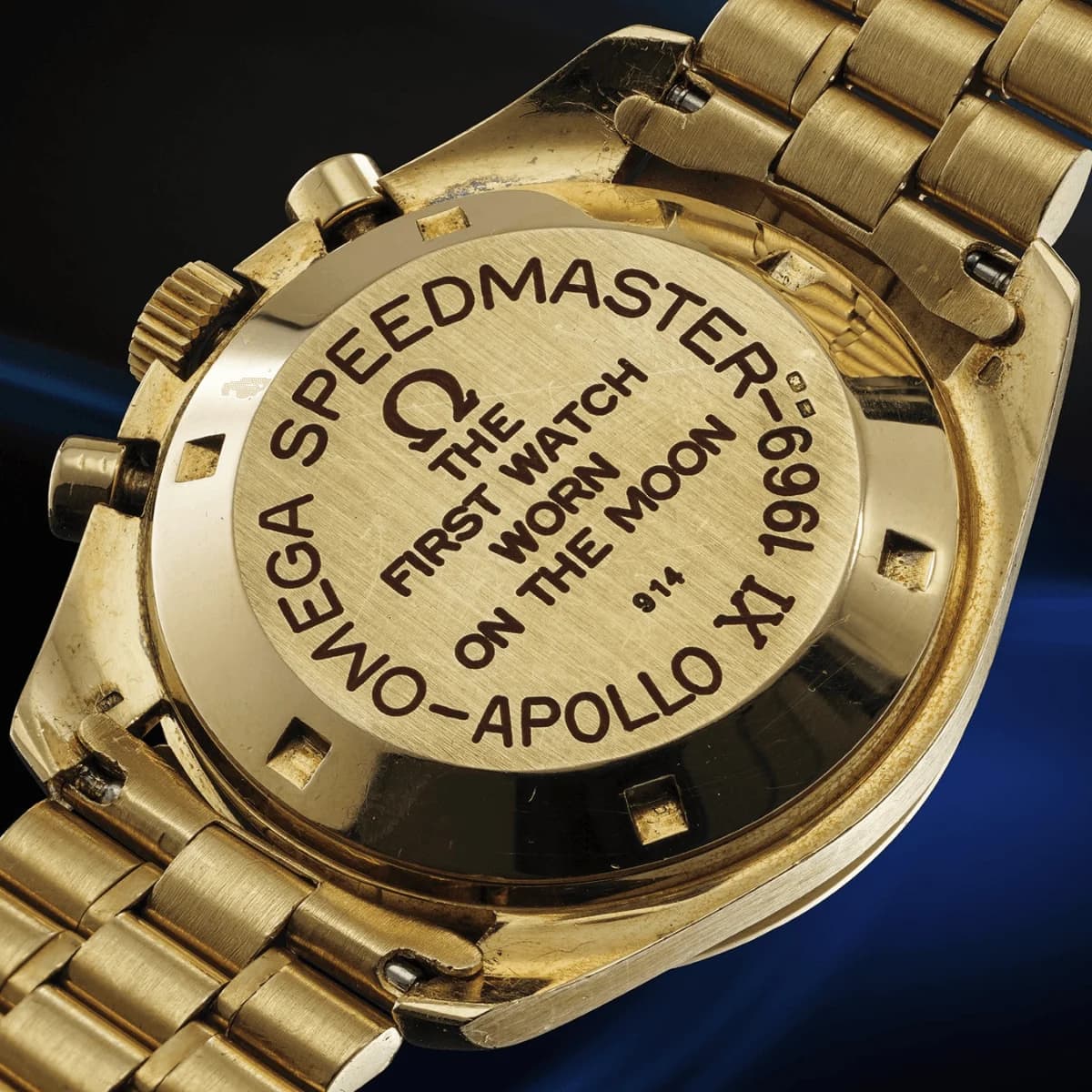
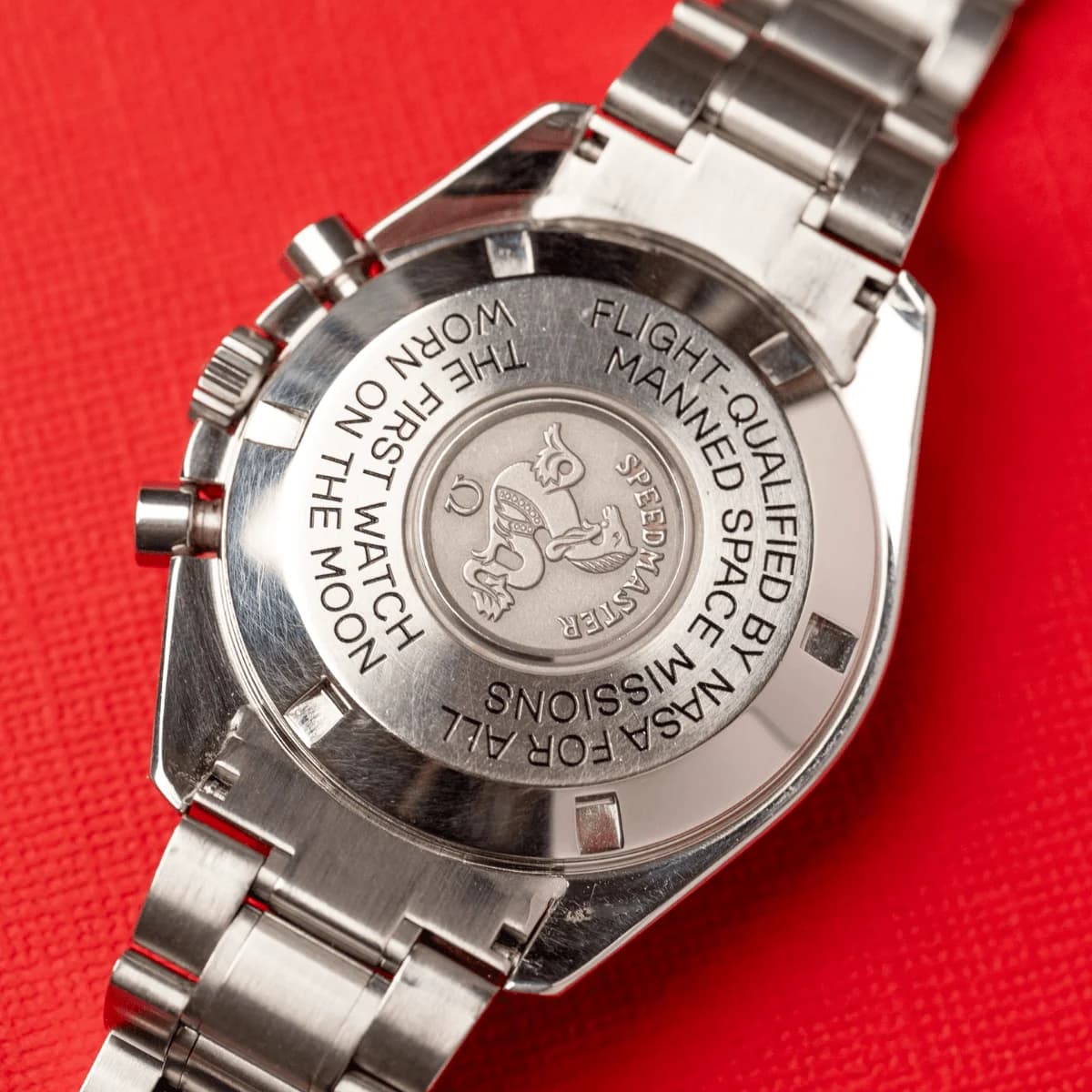
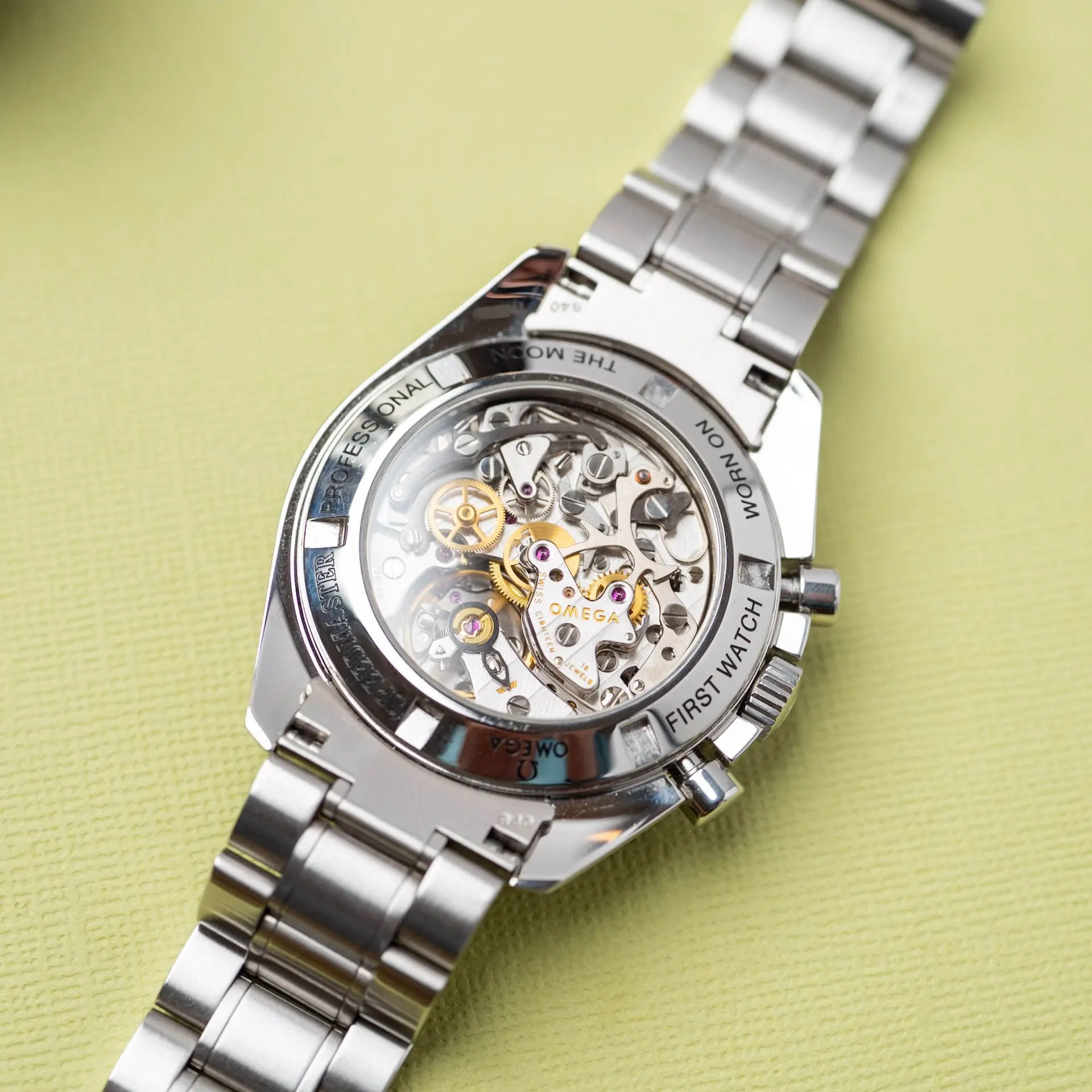
Neil Armstrong, the first man to set foot on the lunar surface, left his watch inside the lunar module—the onboard electronic timer had failed, and the Speedmaster was used as a backup. It was therefore Buzz Aldrin who became the first man to wear a watch during a lunar EVA. From then on, Omega engraved on the caseback of all subsequent productions: “Flight-Qualified By NASA For All Manned Space Missions — The First Watch Worn On The Moon”.
The 105.012 remains today one of the most sought-after collector’s pieces in watchmaking history. Examples bearing serial numbers linked to Apollo mission crews reach record prices at auction. Notably, the Speedmaster worn by Buzz Aldrin during Apollo 11 has been officially missing since 1970, following a return to NASA—it has never been sold. This detail has only reinforced its legendary status.
The 145.012 reference: the last Calibre 321
The 145.022 reference: the Calibre 861 and nineteen years of dominance
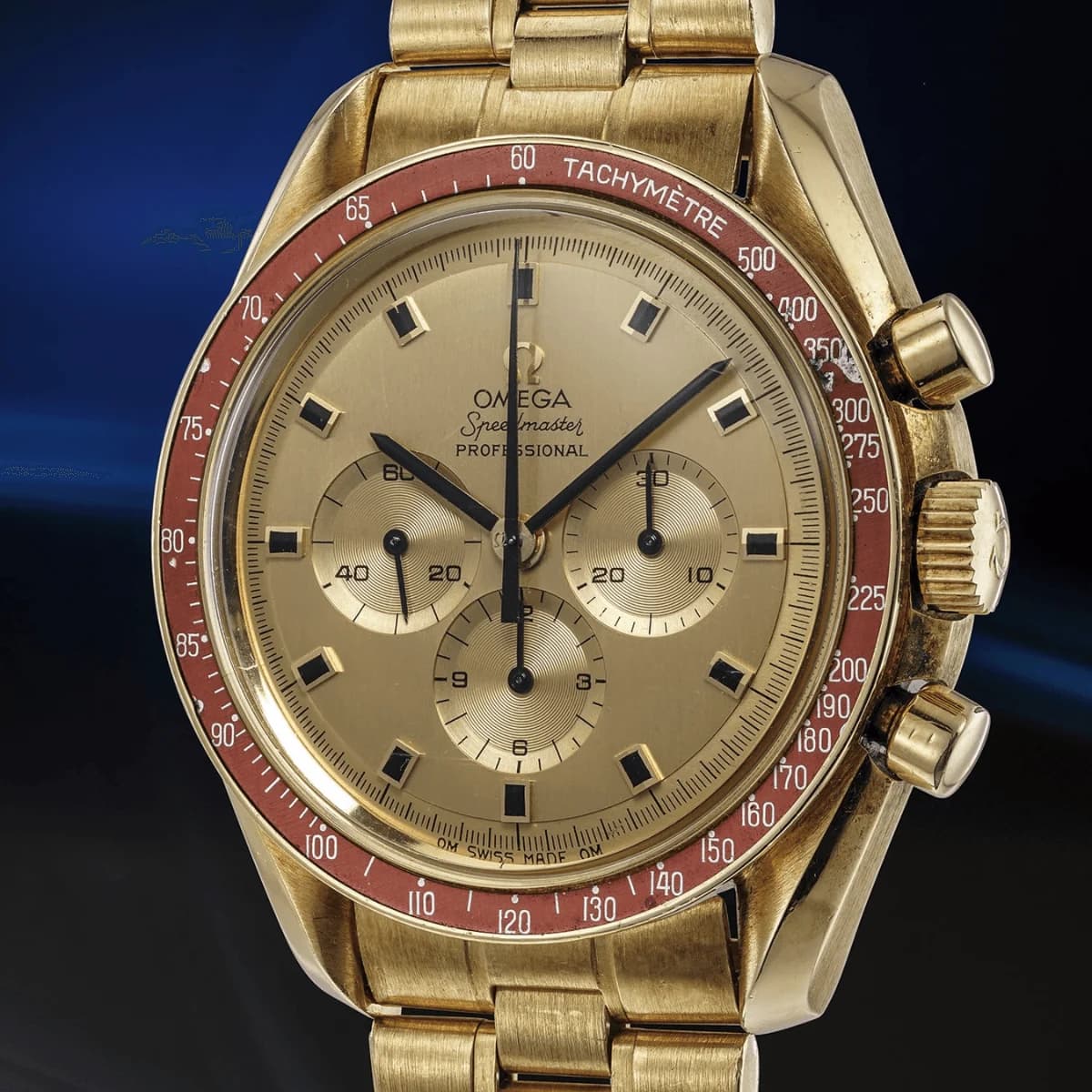
It is also worth noting that during a gala dinner in Houston in November 1969, nineteen astronauts from the Apollo missions each received an 18k gold Speedmaster, reference BA 145.022. Three additional pieces were awarded posthumously to the families of the Apollo 1 crew—Gus Grissom, Ed White, and Roger B. Chaffee. These watches are among the most highly collectible Speedmasters in the world.
The 3590.50 and 3592.50 references: the Calibre 1861
In 1988, the 145.022 was discontinued. Omega streamlined its range around a single model and introduced the Calibre 1861, an improved version of the 861 with rhodium-plated finishes, better corrosion resistance, and a more refined aesthetic. This was during the revival of mechanical watchmaking, and the Speedmaster fully benefited from it.
The 3590.50 (solid caseback) and 3592.50 (sapphire caseback, allowing the movement to be admired—generally fitted with the Calibre 1863, the decorated version of the 1861) coexisted until the late 1990s.
It was also during this period that tritium-based luminous dials were gradually phased out in favor of Super-Luminova, a non-radioactive pigment. The only notable cosmetic change on a model whose fundamental design dates back to the 1960s. That says it all.
In 1993 and 1994, the Speedmaster underwent another full-scale test: flown aboard the Russian space station Mir, it withstood several months of extreme orbital conditions without failure. A certificate signed by the crew attests to this. NASA had already recertified it for the Space Shuttle program in 1978. The Speedmaster is now one of the most extensively tested watches in history.
The 3570.50 reference: the Moonwatch in its definitive form
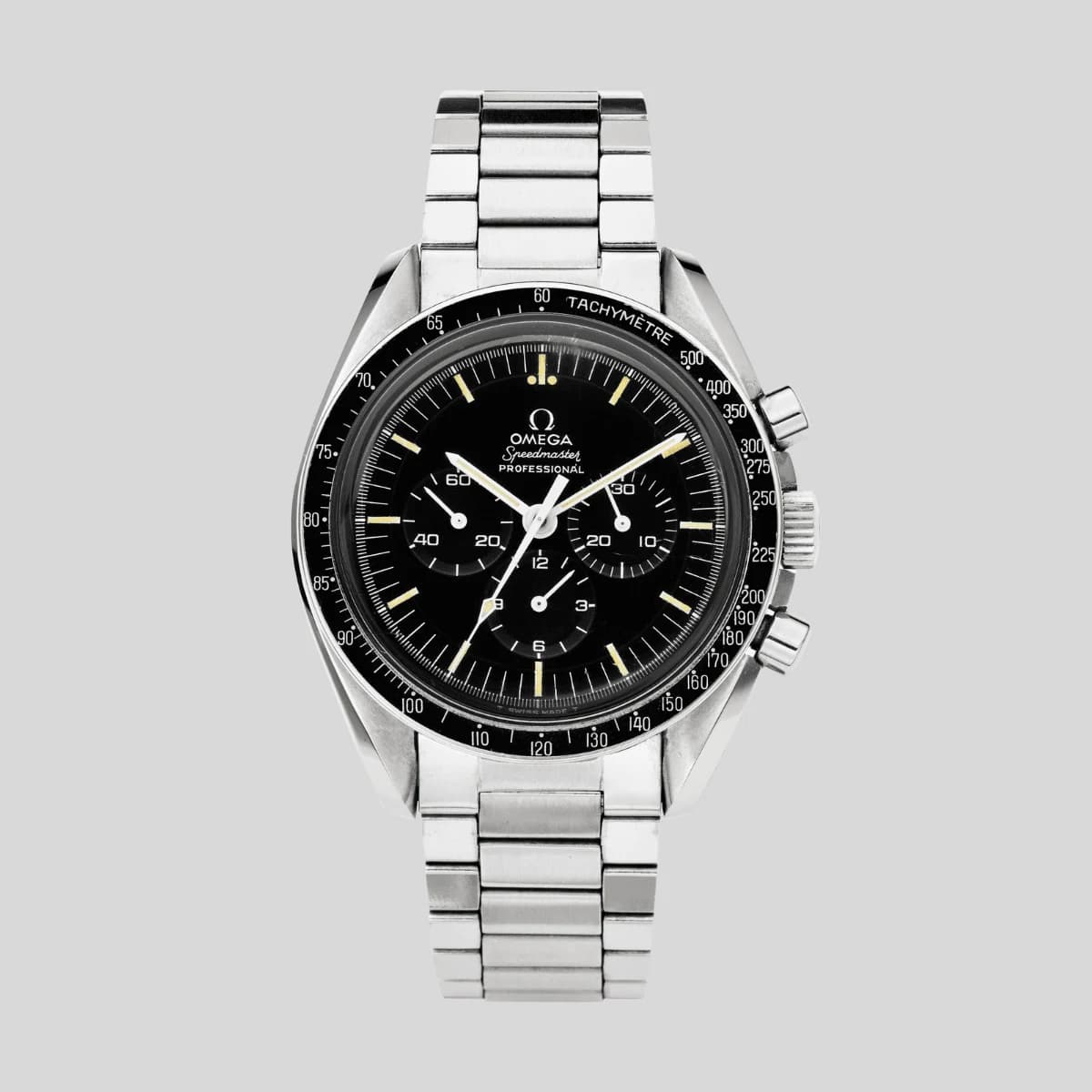
From 1997 onward, the Speedmaster Professional stabilized around the 3570.50 reference. The design remained almost identical to that of the 1960s. The Calibre 1861 was retained. The differences lay in the details: finishing, bracelet, and caseback construction. This reference was produced until 2021, confirming the exceptional longevity of a model that has spanned decades without needing to reinvent itself.
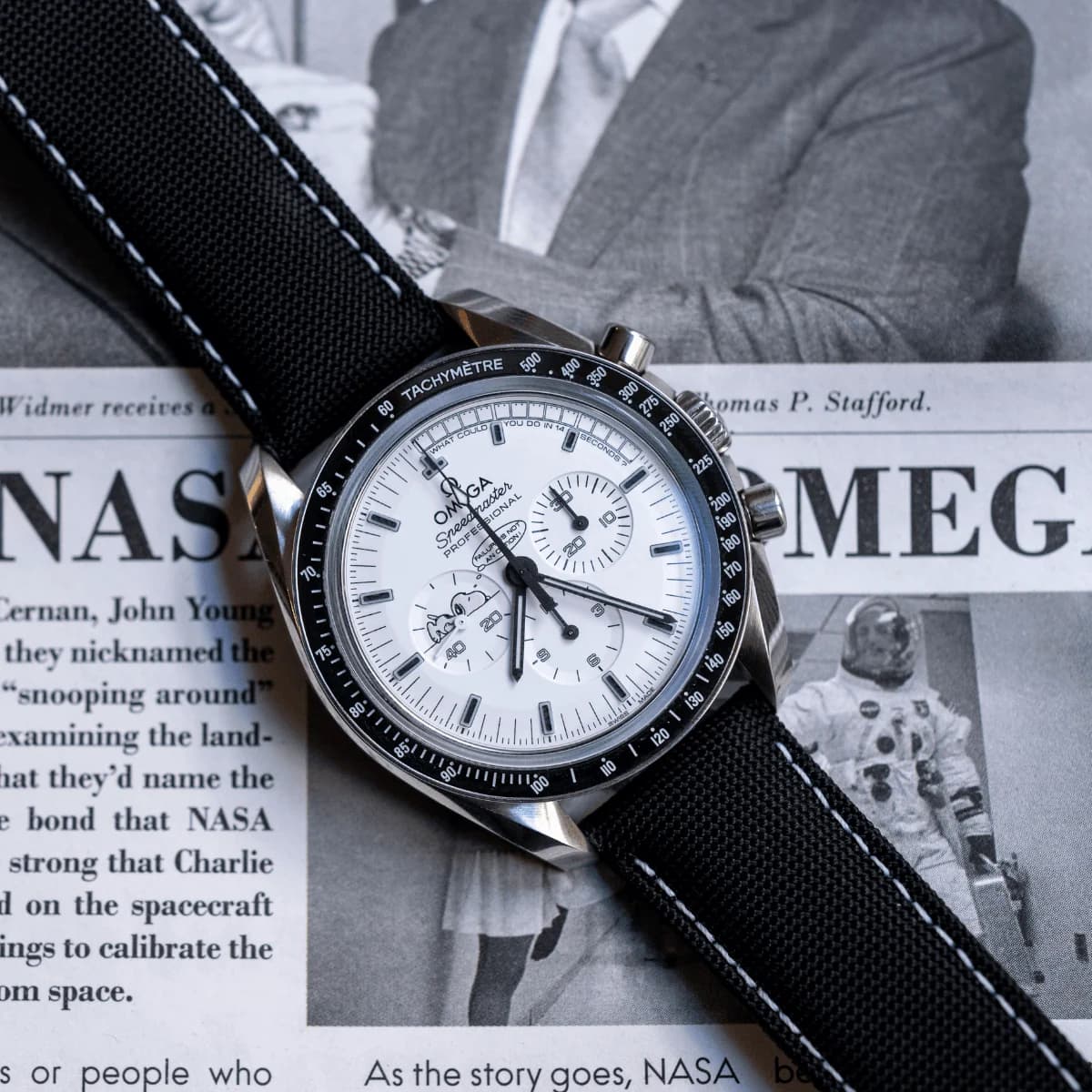
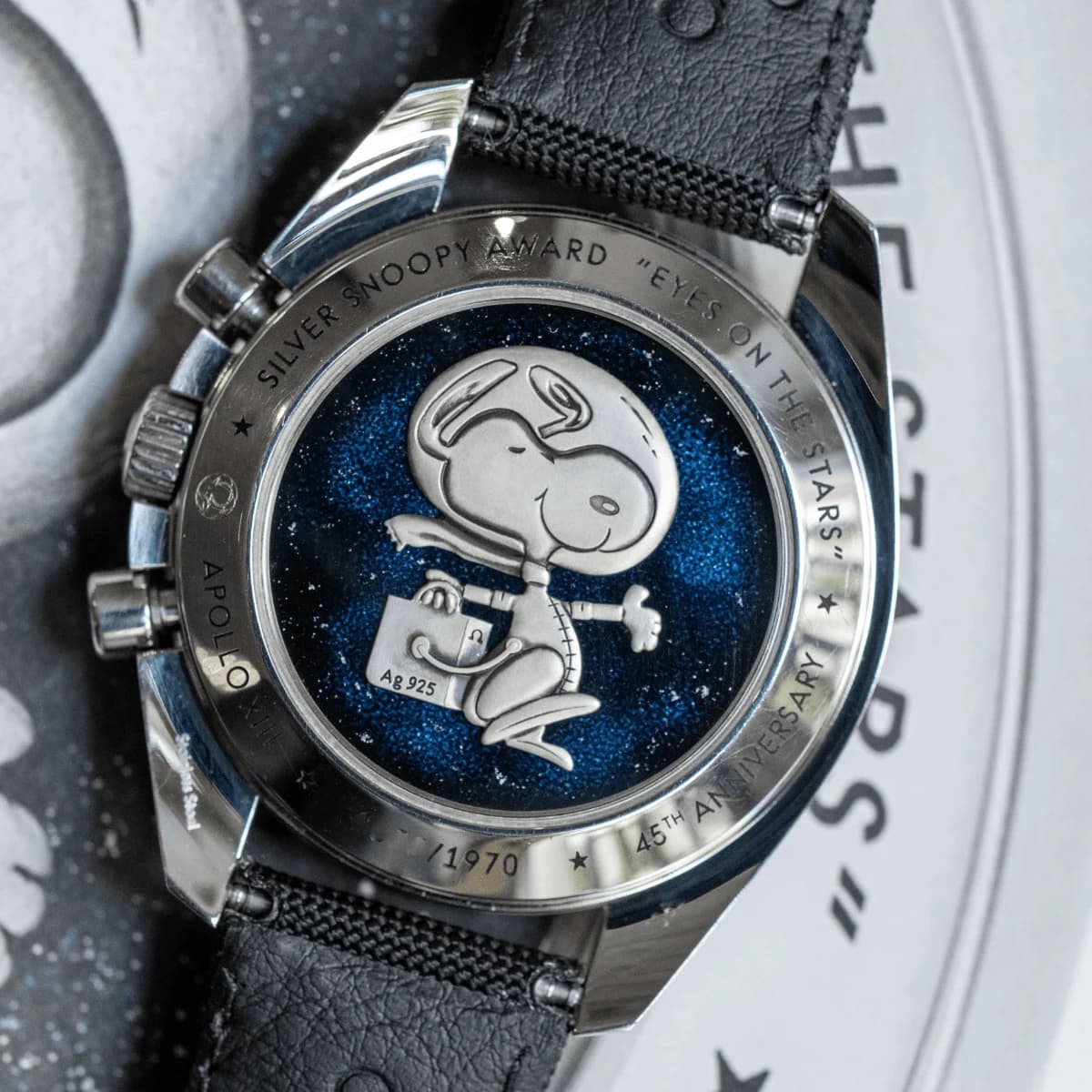
During this period, Omega multiplied limited and commemorative editions: Apollo mission anniversaries, tributes to Snoopy (the Peanuts character that became a mascot of NASA spaceflight safety), versions in precious metals, anthracite or champagne dials… The Speedmaster became as much a collector’s item as a precision instrument. It never gave up being both.
Reference 311.30.42.30.01.xxx
PProduced between 2014 and 2021, the 311 reference embodies the final evolution of the Speedmaster Moonwatch before its transition to a new generation. It incorporates the aesthetic codes most sought after by collectors, notably a “step dial” and the famous “dot over 90” detail, both directly inspired by historical models.
Powered by the Calibre 1861, it remains faithful to a traditional architecture with a lever escapement, no hacking seconds, and a power reserve of around 48 hours. A simple, proven configuration, perfectly in line with the spirit of the Moonwatch.
With this reference, Omega effectively marks the end of a cycle: that of a Speedmaster still very close to its roots, before the arrival of more significant technical evolutions.
Two versions should be noted:
- 311.30.42.30.01.005 with Hesalite crystal and a solid caseback (the most “original Moonwatch”)
- 311.30.42.30.01.006 with sapphire crystal and a transparent caseback
The Snoopy Silver Award 45th Anniversary limited edition
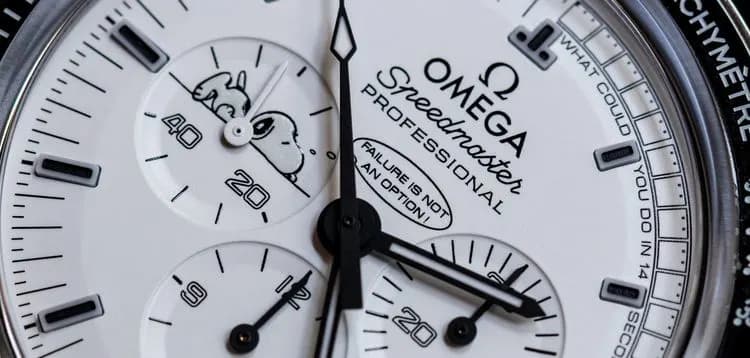
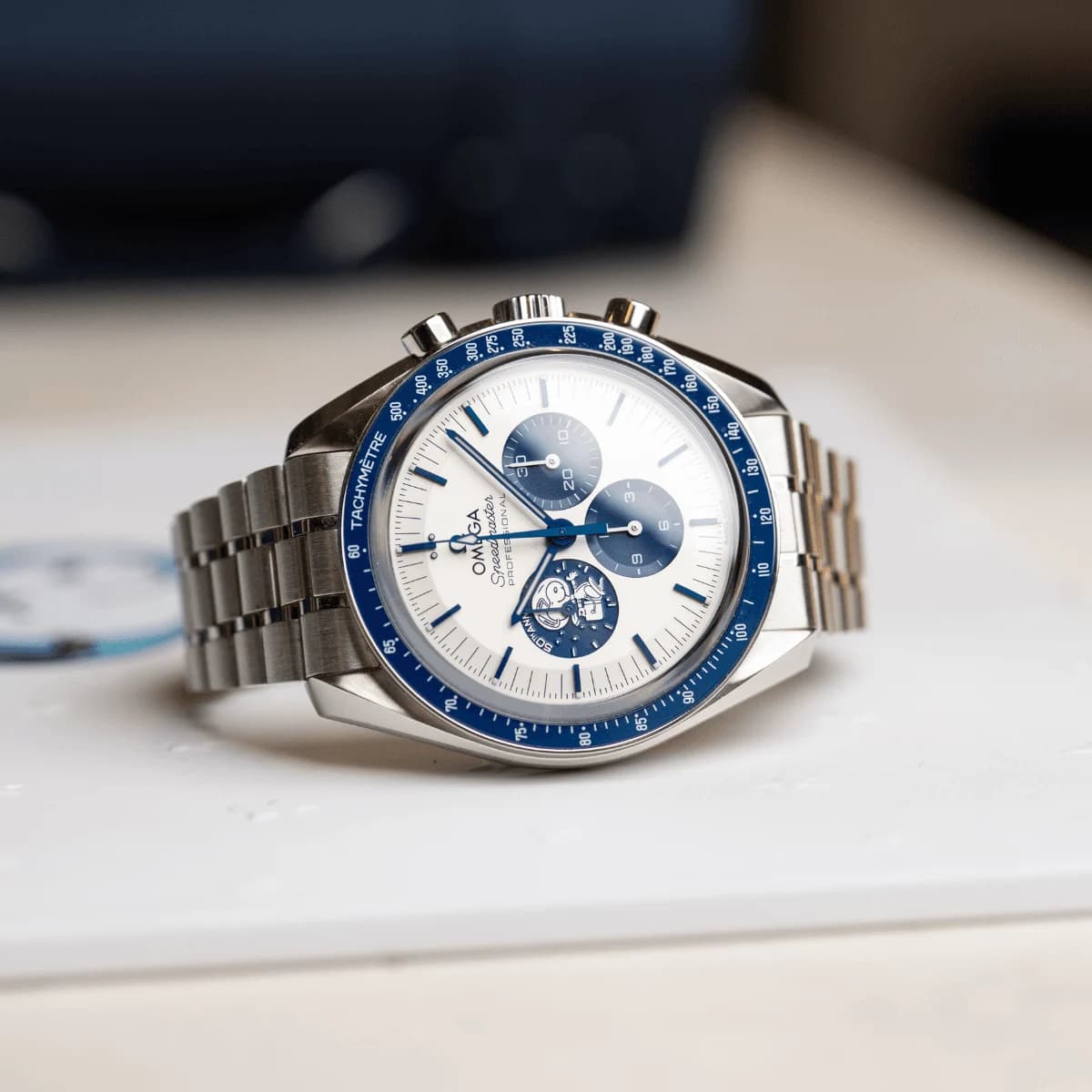
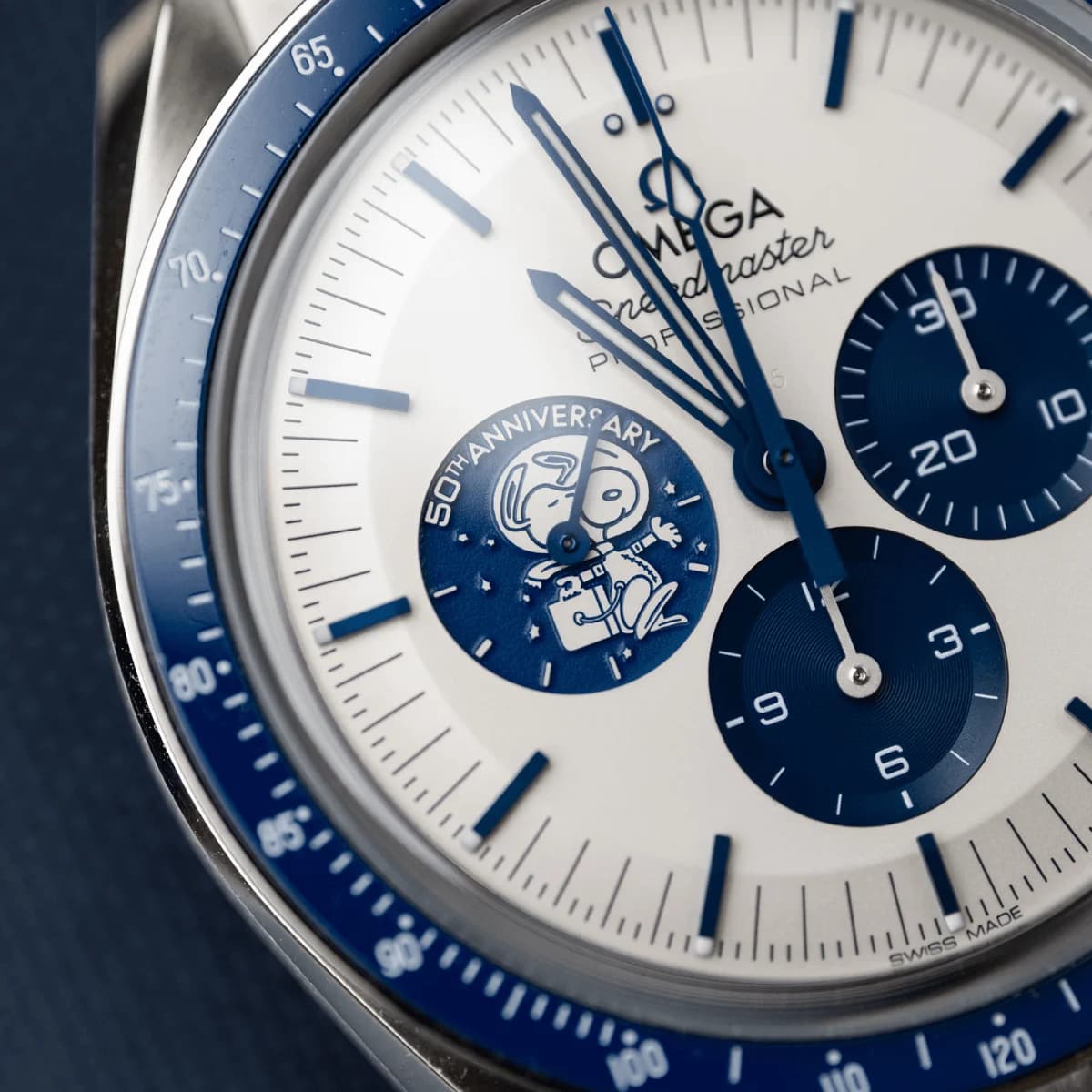
It’s hard to discuss the 1861 generation without mentioning one of its most striking variations: the Silver Snoopy Award 45th Anniversary. Introduced in 2015, this special edition celebrates the distinction awarded by NASA to Omega following the Apollo 13 mission, in recognition of the crucial role played by the Speedmaster.
While the dial remains relatively understated with its blue accents and Snoopy medallion, it is especially on the caseback that the watch stands out. The animated caseback features the Earth, the Moon, and the Apollo module, in a poetic yet technical representation of the mission.
Also powered by the Calibre 1861, this version retains all the DNA of the classic Moonwatch, while adding a strong narrative dimension. A unique piece that has become a cult favorite among collectors.
It carries the reference 311.32.42.30.04.003.
The 310.30.42.50.01.001 reference: the Calibre 3861
In 2021, to celebrate the 50th anniversary of Apollo 11 (with a two-year delay due to the pandemic), Omega carried out the most significant transformation of the Speedmaster Professional since 1969. The manufacture introduced the Calibre 3861, featuring the Omega Co-Axial escapement, a Master Chronometer certification issued by METAS (resistance to magnetic fields up to 15,000 gauss), a 50-hour power reserve, and a hacking seconds function (stop-seconds). The movement is COSC-certified, and the complete watch receives the Master Chronometer certification from METAS. It represents a considerable technological leap.
Snoopy 310.32.42.50.02.001 "Silver Snoopy Award" - 50th anniversary
Ed White 311.30.40.30.01.001
It pays tribute to the third-generation model worn during the first American spacewalk. It features the legendary Calibre 321, recreated according to its original specifications.
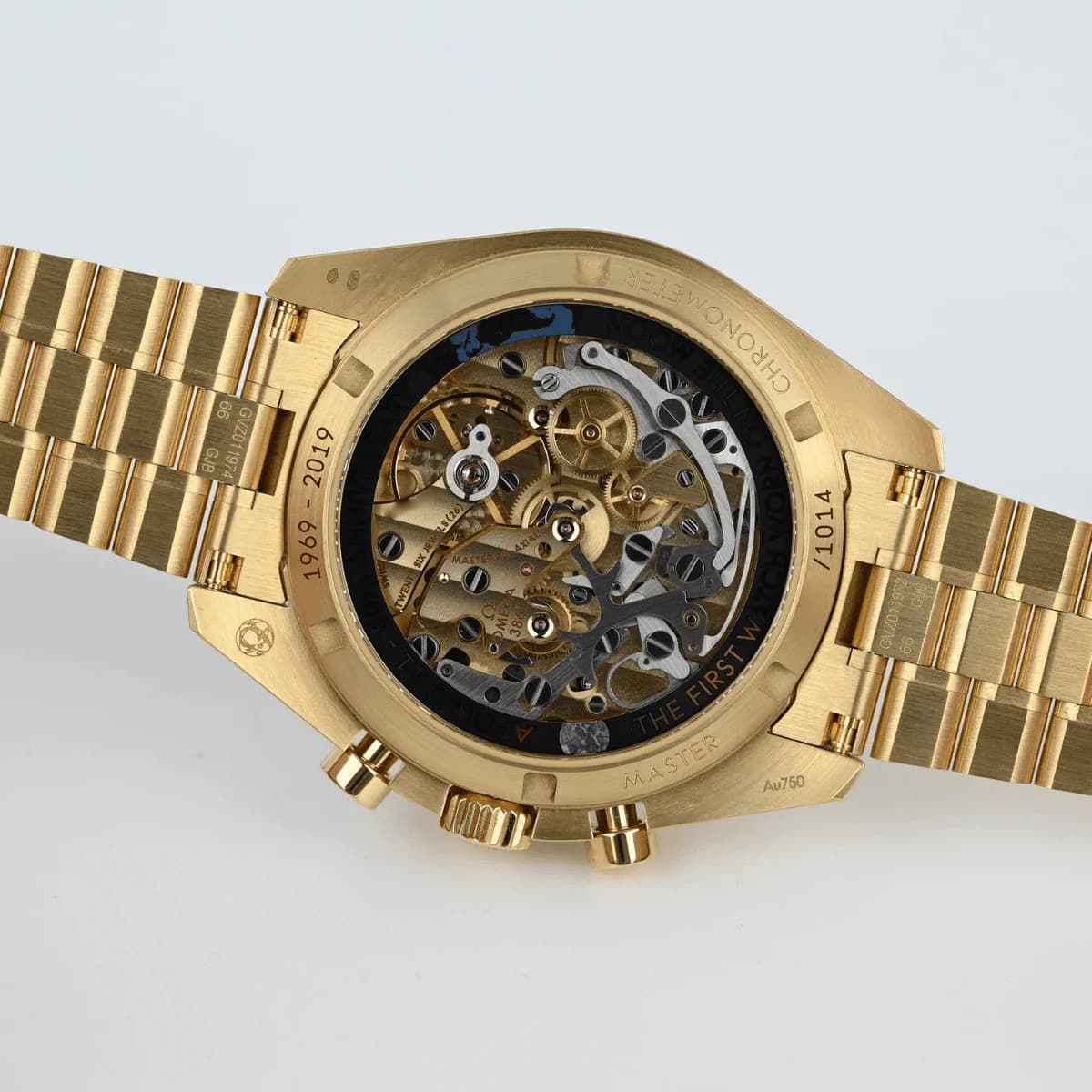
Apollo 310.60.42.50.99.001 50th anniversary
To commemorate the anniversary of the OMEGA watch presented to astronauts in 1969 for the first Moon landing, Omega produced a limited edition Speedmaster in 18k yellow gold, with only 1,014 pieces available.
This information is based on observation and cross-referencing from professional sources, collectors, and public archives. Omega does not publish its production figures by reference. These details have not been officially confirmed by the manufacture.
The Speedmaster in popular culture
Still deeply rooted in the collective imagination, the Speedmaster has made numerous notable appearances on screen. It can notably be seen in the film First Man by Damien Chazelle, dedicated to Neil Armstrong—with prop masters carefully reproducing period-correct models. But its most striking appearances are in real life: worn by Buzz Aldrin on the Moon, by ambassadors such as George Clooney during public appearances, or Rory McIlroy before and during his tournaments, and even by cosmonauts aboard the Mir, the Speedmaster spans eras without needing fiction to cement its legend.
Also worth noting is the MoonSwatch phenomenon launched by Swatch Group in 2022: a Bioceramic Speedmaster priced under €300, released in eleven planetary versions, which generated worldwide queues and reignited interest in the model among a new generation.
Some collectors were outraged. Others saw it as proof that the Speedmaster’s DNA is strong enough to endure across all variations.
Personally, I won’t give my opinion on the matter—I might offend a few collectors. We’ll see in a few years what impact it has had on Generation Z (if we’re still around to see it…). After all, my own passion for chronograph watches began with Swatch when I was just a kid.